The A/P Open Item Adjustment application has two
separate and distinct functions.
First, it allows changes to be made to the due date,
discount date, and discount balance of an A/P open item. These changes may be
required because of an entry error when the transaction was originally entered
or for some other reason. This amounts to changing the terms on an invoice.
Second, it allows entry of manual payments made
toward vendor invoices. Generally, for some reason, a check has been written
manually (not printed by the computer) to pay vouchers and it now must be
entered into the system.
These two functions are performed with two different
transaction types. These types are T (Change Voucher Terms) and M (Manual
Payment). The changes to be made are entered at the terminal and are stored in
a temporary file called the Open Item Adjustment Transaction File. Once the
data has been entered and verified as correct, it can be posted to the Open
Item File. An Open Item Adjustment Register is printed, which can be used as
an audit trail for these adjustments.
A single manual check may pay several different
vendor invoices. This is done by entering a separate transaction for each
vendor invoice paid. To verify that the check amount matches what was entered,
print the Open Item Adjustment List and compare the check total against the
actual check amount.
In order for vouchers being paid by a manual check
to be shown as fully paid, you must run Manual Check Register Report from the
Reports pull down window after posting Open Item Adjustments.
Select A/P Open Item Adjustment from the pull
down A/P Processing window. The following screen will then be displayed:
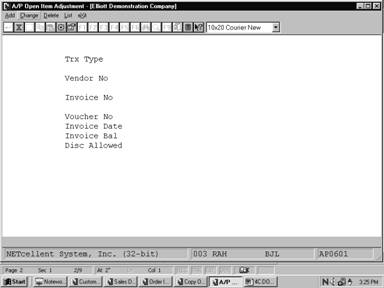
The following options are available:
* Select the desired mode
from the A/P Open Item Adjustment menu bar
* Enter the data requested on
the screen
* To exit press the ESC or
F10 key when the cursor is positioned for entry of the first field on the
screen
To return to the menu bar, press the ESC or
F10 key. To leave this application, press X for EXIT when positioned at the
menu bar.
Entry Field Descriptions
|
Name
|
Type
and Description
|
|
Trx Type
|
1 alphanumeric character.
The valid entries for this field are:
T = Change
Voucher Terms
M = Manual
Payment
Enter T if you wish to change the due date, discount
date, or discount balance on a voucher. Enter M if you wish to enter a
manual payment, which has been made toward one or more vendor invoices
already on file.
This field defaults to the
last entry.
|
|
Vendor No
|
6 alphanumeric characters.
Enter the vendor number of
the vendor whose invoice is being adjusted. The vendor's name will display
automatically to the right. If you do not know the vendor number, press the
F7 key and a search for the vendor by number can be done or press the F8 key
and a search for the vendor by name can be done.
|
|
Invoice No
|
8 alphanumeric characters.
Enter the invoice number of the original vendor invoice
for which the adjustment is being made.
If you do not know the
invoice number, press RETURN, and you will be allowed to enter the voucher
number instead.
|
|
Voucher No
|
6 numeric characters
(999999).
This field is only entered if you choose not to enter
the invoice number and enter this number instead.
This is the voucher number
that was assigned to the invoice during the A/P Transaction Processing.
|
|
Invoice Date
|
A date in the standard date
format.
This field is displayed automatically, no entry is
required.
This is the date of the
original invoice.
|
|
Invoice Bal
|
9 numeric digits with 2
decimal places and an optional minus sign (9,999,999.99‑).
This field is displayed automatically, no entry is
required.
This amount indicates how much of the invoice amount
still has not been paid. If it is negative, it means that the invoice has
been overpaid.
The invoice balance is
arrived at by subtracting the partial payments and discounts taken from the
invoice amount.
|
|
Disc Allowed
|
9 numeric digits with 2
decimal places and an optional minus sign (9,999,999.99‑).
This field is displayed automatically, no entry is
required.
This field indicates the
amount of early payment discount that was originally allowed on the invoice.
|
"T" Type Adjustments (Change Voucher Terms)
|
Name
|
Type
and Description
|
|
Old Due Date
|
A date in the standard date
format.
This field is displayed
automatically, no entry is required. This is the due date of the invoice.
|
|
Old Disc Date
|
A date in the standard date
format.
This field is displayed
automatically, no entry is required. This is the last date that any early
payment discount can be taken on this invoice.
|
|
1. New Due Date
|
Enter a date in the standard
date format.
The old due date will be
displayed on the screen. If you wish to change it, enter the new due date
here. If you do not wish to change it, press RETURN.
|
|
2. New Disc Date
|
Enter a date in the standard
date format.
The old discount date will
be displayed on the screen. If you wish to change it, enter the new discount
date here. If you do not wish to change it, press RETURN.
|
|
3. New Discount
|
9 numeric digits with 2
decimal places and an optional minus sign (9,999,999.99-).
The original discount amount
will be displayed on the screen. If you wish to change it, enter the correct
discount amount here. If you do not wish to change it, press RETURN.
|
"M" Type Adjustments (Manual Payments)
|
Name
|
Type
and Description
|
|
1. Check No
|
6 numeric digits (999999).
Enter the check number of
the check, which is being entered.
|
|
2. Check Date
|
Enter a date in the standard
date format.
Enter the check date of the
check that is being entered.
|
|
3. Gross A/P Amt
|
9 numeric digits with 2
decimal places and an optional minus sign (9,999,999.99‑).
Enter the amount of the voucher, which is being paid
off. If a discount is being taken, the gross A/P amount will be the check
amount plus the discount amount.
For example, if a check for
$99.00 has been written to pay off a $100 voucher with a $1.00 value
discount, then the amount entered here would be $100.00, since A/P is being
reduced by $100.00.
|
|
4. Disc Taken
|
9 numeric digits with 2
decimal places and an optional minus sign (9,999,999.99‑).
Enter the discount taken. In the above example, the
discount taken would be $1.00.
After this field has been
entered, the net cash amount will be displayed on the screen. If only one
vendor invoice was paid by the check, the net check amount should equal the
amount of the check; otherwise, the net cash amount represents the part of
the check amount applied to this vendor invoice. The total net cash amounts
from all adjustments with the same check number should equal the amount of
the check. This should be verified on the Edit List. If they do not, the
adjustments have not been entered correctly.
|
|
5. Cash Account
|
An account number in the
standard account number format.
This field will only be entered if multiple cash
accounts are used.
Enter the cash account from which the check was drawn.
Pressing the F7 key will
allow you to search for the account by number or pressing the F8 key will
allow you to search for the account by name. .
|
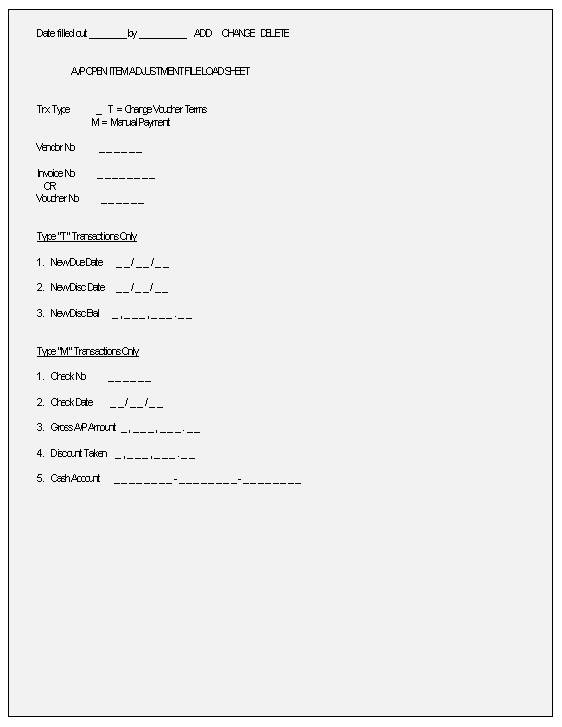
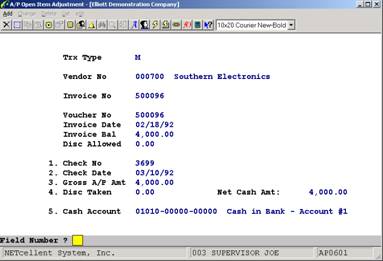 Screens
Manual Payment Transaction
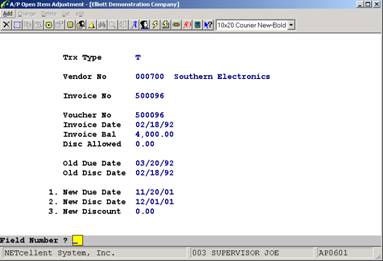
Change Voucher Terms
Transaction
A /
P O P E N I T E M A D J U S T M E N T E D I T L I S T
Trx Types: T = Change Voucher
Term M = Manual Payment
Trx Vendor Invoice Vouchr
Invoice Invoice‑Bal Old/New Old/New Old‑Disc‑Bal
Check‑No Gross‑Ap‑Amt Net‑Cash‑Amt
Typ No No
No Date Discount‑Bal Disc‑Date Due‑Date New‑Disc‑Bal
Chk‑Date Disc‑Taken Cash‑Acct‑No
M 000200 500100 500100
01/24/93 2,248.00 456321
2,248.00 2,113.12
134.88
01/24/93 134.88 01010‑00000‑00000
Check‑Totals: 2,248.00 2,113.12
134.88
M 000700 523640 Invoice
Not On File Or Fully Paid
Check‑Totals: .00 .00
.00
T 000100 930124 500099
01/24/93 289.00 02/23/93 03/25/93 14.45
14.45 02/23/93 03/24/93 .00
T 000200 18857 Invoice
Not On File Or Fully Paid
T 000300 23528 Invoice
Not On File Or Fully Paid
Grand‑Totals:
2,248.00 2,113.12
134.88
2 A/P Open Item
Adjustments
The
Post Adjustment Transactions application transfers prior adjustments
into the A/P Open Item file among others. Consequently, posting serves
to automatically adjust the amount that your business owes to a given
vendor.
When
performing a posting, the system prints a journal of all transactions that were
posted.
Select Post Adjustment Transactions
from the pull down A/P Processing window. The following screen
will then be displayed:
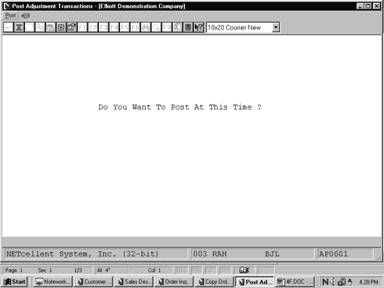
Post Adjustment Transactions Entry Screen
The following options are available:
* Enter the data requested on
the screen
* To exit press the ESC
or F10 key when the cursor is positioned for entry of the first field on
the screen
To return to the menu bar, press the ESC
or F10 key. To leave this application, press X for EXIT
when positioned at the menu bar.
Entry Field Descriptions
|
Name
|
Type
and Description
|
|
Do You Want To Post At This Time ?
|
Y or N.
Enter Y if you want
to post adjustment transactions or N to decline.
|
Screens
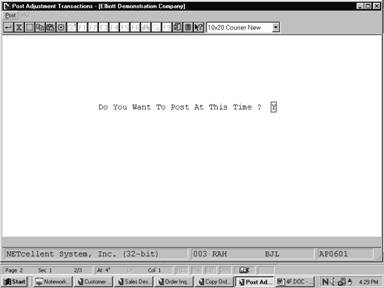
Post Adjustment Transactions
REPORTS
A / P O P E N I T E M A D J U S T M E N T R E G I S T E R
Trx Types: T = Change Voucher Term
M = Manual Payment
Trx Vendor Invoice Vouchr
Invoice Invoice‑Bal Old/New Old/New Old‑Disc‑Bal Check‑No
Gross‑Ap‑Amt Net‑Cash‑Amt
Typ No No No
Date Discount‑Bal Disc‑Date Due‑Date New‑Disc‑Bal
Chk‑Date Disc‑Taken Cash‑Acct‑No
M 000200 500100 500100
01/24/93 2,248.00 456321
2,248.00 2,113.12
134.88 01/24/93 134.88 01010‑00000‑00000
Check‑Totals: 2,248.00 2,113.12
134.88
M 000700 523640 Invoice Not
On File Or Fully Paid
Check‑Totals:
.00 .00
.00
T 000100 930124 500099
01/24/93 289.00 02/23/93 03/25/93 14.45
14.45 02/23/93 03/24/93 .00
T 000200 18857 Invoice Not
On File Or Fully Paid
T 000300 23528 Invoice Not
On File Or Fully Paid
Grand‑Totals: 2,248.00 2,113.12
134.88
2 A/P Open Item Adjustments

